Fact-checked AI explainers, made by an agentic pipeline.
New AI research papers in, short explainer videos out. Written with LangGraph agents, checked against their sources, presented by a custom-built avatar and improved by their own analytics.
Peace AI Briefing
The project page shows how the system works, from paper to published video and back.
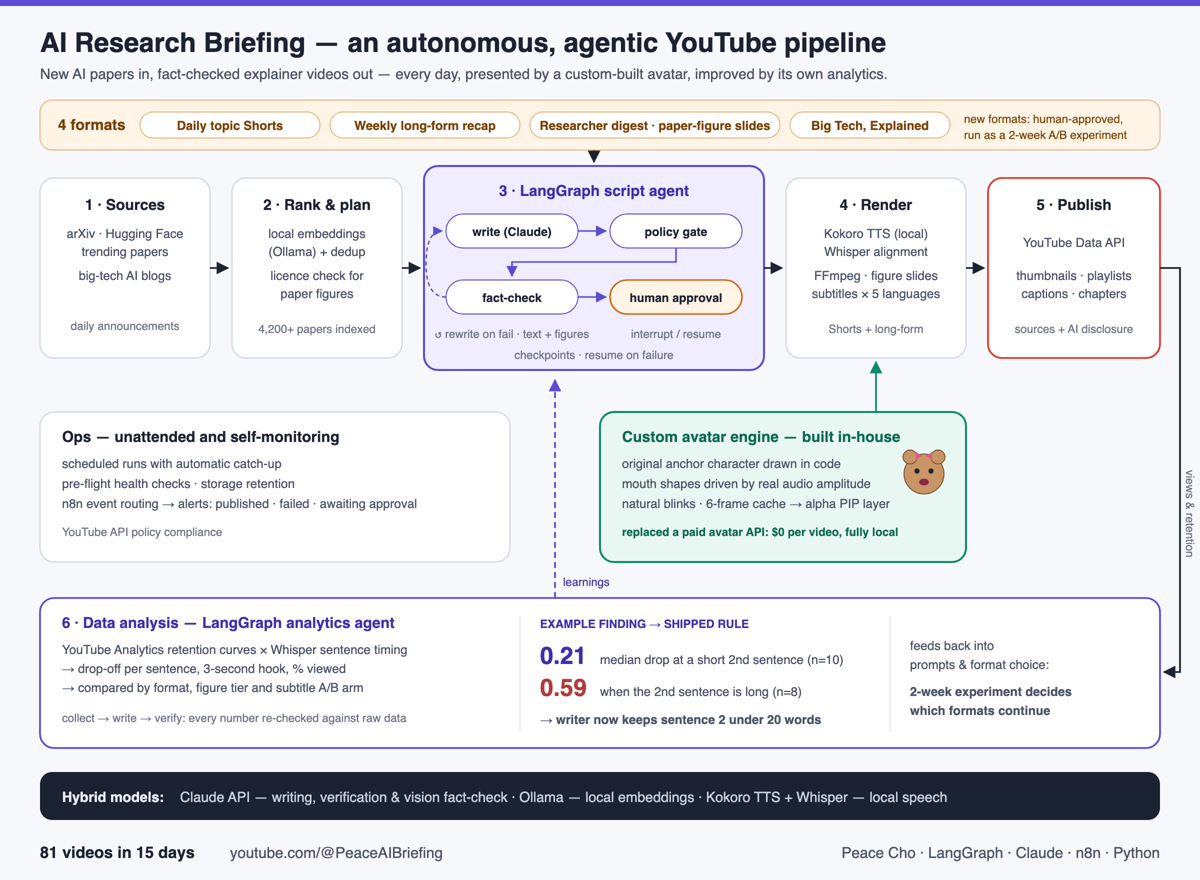
AI Research Briefing pipeline
Sources → ranking → LangGraph script agent (rewrite loop, fact-check, human approval) → render → publish, with a custom avatar engine and an analytics agent that feeds what viewers do back into the next scripts.
Open the architecture →How it works
Three parts I designed and built, each doing one job.
Agentic scripting
A LangGraph agent writes each script, rewrites it when a policy gate fails, fact-checks claims against the paper's text and figures, and pauses for human approval on new formats.
Custom avatar engine
An original anchor character drawn in code. Mouth shapes follow the real audio, it blinks, and it is layered into the video as a transparent overlay. No paid avatar service.
Analytics loop
An analytics agent lines up YouTube retention with each spoken sentence. Findings become rules: a short second sentence held viewers far better (median drop 0.21 vs 0.59), so scripts now keep it under 20 words.
Channels
Each channel is its own product, with its own audience, sources and anchor.
Peace AI Briefing
New AI research papers and AI industry news, explained in Shorts and a weekly long-form recap, with subtitles in Korean, Japanese, Chinese, Spanish and German.
Peace Home & Rates Briefing
Toronto home prices, rents and mortgage rates, explained from official data with our own charts, for buyers, owners and renters. Not selling anything. Presented by an anchor drawn from Peace's own sketch.
OneTap Notes
A second product on the same idea: AI does the work end to end, and every claim is measured.
See the OneTap Notes architecture →
Multilingual voice notes
One tap records a meeting. About a minute later, a speaker-attributed summary and a translation into your language arrive by email. iOS, Android, Wear OS and the web, with one Python backend.
- Four speech engines benchmarked on our own evaluation set (14 meetings, 6 languages). Soniox cut Korean character error rate from 10.3% to 6.5% versus Whisper.
- Speaker diarization raised correct action-item owners from 11/21 to 15/21.
- About $0.11 of API cost per meeting hour.
Unattended delivery pipeline
GitHub Actions ships every platform without manual steps.
- iOS to TestFlight through the App Store Connect API.
- Android and Wear OS to Google Play tracks; web to Cloudflare Pages.
- Backend deploys are health-checked and roll back automatically.
- Secret scanning, 81 automated tests and a weekly model-quality eval.
About
Peace Cho
Software engineer · iOS → applied AI
- Designed and runs the agentic pipeline behind Peace Media: agents, avatar engine, analytics.
- Built OneTap Notes end to end: iOS, Android, Wear OS, web and backend, shipped by unattended GitHub Actions pipelines.
- LLM fine-tuning: Qwen2.5 with QLoRA for news-style research briefings.
- Earlier: Bosch Research (Palo Alto), ATR (Kyoto); B.Sc. Computing Science, Simon Fraser University.